
What the standard photos actually show
Three angles, fixed by category, compared against the label on the product and against your remark. Everything else in the frame is incidental.
Every rule on this page is quoted from PonyBuy own help centre with a link to the page it came from. How this site earns
Three photographs, three fixed angles, one written scope
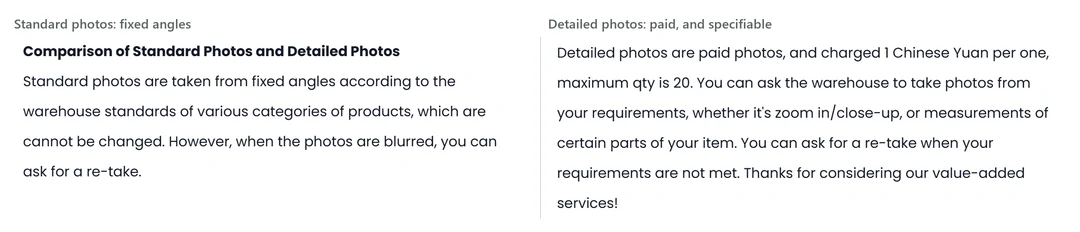
The standard set is not a photo shoot and was never meant to be one. PonyBuy describes it in a single sentence: the quality inspection process usually provides three standard photos of different angles of the product, front, back, and side or logo. It then explains why you cannot ask for a fourth. The angles are taken according to the warehouse standard for each category of product, and those standards are not adjustable per order.
The one thing you can ask for is a re-take, and PonyBuy says so plainly: when the photos are blurred, you can ask for them again. That is a quality guarantee about the photograph, not about the product.
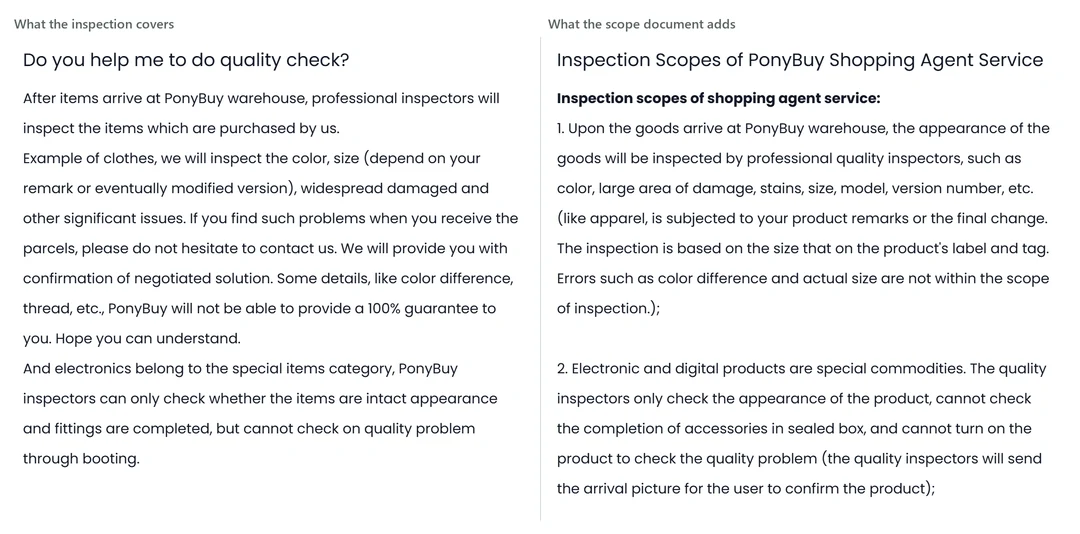
What the inspector is comparing against is narrower still. For clothing the check runs against the size on the product label and tag, and against whatever you wrote in the remark or whatever change was eventually agreed. Not against the seller listing. Not against a reference pair. Not against a batch.
Reading the QC photos: what to look at, and what is simply not there
Work through the left column first. Every item on it is something PonyBuy has committed to looking at, so a mistake there is a mistake you can raise. Nothing in the right column is a failure of the inspector; each one is an exclusion PonyBuy wrote down in advance.
Worth studying in the photo
- The model and version number, against the box or the label rather than against your memory of the listing.
- The size printed on the tag. That is the size the inspection is based on, so it is the one you can argue about.
- Stains and large area damage, which are named in the scope.
- The colourway as photographed, remembering that colour difference is excluded and colour as such is not.
- Whether the visible fittings are there at all. For electronics this is most of what the inspection can offer.
Not in the photo, by design
- Colour difference. PonyBuy names it as outside the scope in the same breath as it names colour inside the scope. The distinction is between the wrong colour and a slightly different shade of the right one.
- Actual size error, as opposed to the size printed on the tag.
- Use effect. Nothing is worn, tested or switched on.
- Thread ends and comparable small details, on which PonyBuy says it cannot provide a full guarantee.
- What is inside a sealed box. Accessory completeness in a sealed box is not checked, because opening it would end your right to return it.
The sentence that decides most disputes
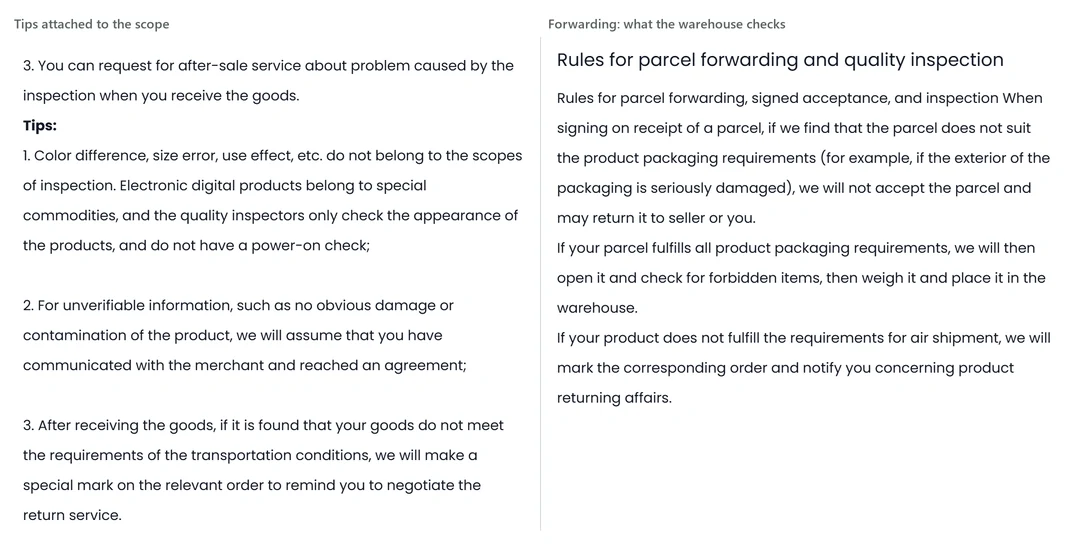
Of everything PonyBuy publishes about inspection, this is the clause that settles the largest number of arguments, and almost nobody reads it before ordering. It is the second of three tips at the foot of the Inspection Scopes page.
Read it slowly. It does not say PonyBuy will check and find nothing wrong. It says that where a thing cannot be verified from the outside, the absence of obvious damage is treated as evidence that you and the merchant already settled the point between you.
For a reps order the consequence is direct. Every claim that lives only in the seller listing, and not on the product itself, sits outside the inspection entirely and rests on the conversation you had before you paid.
For unverifiable information, such as no obvious damage or contamination of the product, we will assume that you have communicated with the merchant and reached an agreement.
Quoted from PonyBuy's help centre, Inspection Scopes, re-read 2026-09-22.
The same scope, applied category by category
The scope is one paragraph for every kind of product PonyBuy handles, which makes it hard to picture. Here it is applied to the categories this site catalogues. The middle column is what the standard set usually resolves; the right hand column is what remains open no matter how good the photograph is.
| Category | Usually settled by the standard set | Still open afterwards |
|---|---|---|
| Sneakers | Colourway, model and version markings, visible damage, the size on the label | Sole construction, stitching density, materials, anything requiring wear |
| Outerwear and hoodies | Colour, print placement, tag size, stains and large damage | Fabric weight, hand feel, how the wash behaves |
| T shirts and jerseys | Print position, colour, tag size, obvious defects | Print durability, fabric weight, how it survives a wash |
| Jeans and sweatpants | Colour, tag size, visible damage or stains | Fit on a body, denim weight, shrinkage |
| Bags | Hardware present and undamaged, colour, shape, visible marks | Leather grade, lining quality, plating durability |
| Hats, belts, eyewear | Colour, model markings, visible damage | Lens coatings, buckle plating, anything needing wear to show |
| Perfume and jewellery | Whether the outer packaging and the item arrived intact | Contents and metal content. Liquids are a sensitive category and are not opened |
| Electronics and watches | Whether the exterior is intact and the visible fittings are complete | Everything else. PonyBuy states its inspectors cannot check quality through booting |
The scope in the middle and right columns is PonyBuy own. Sorting it by category is this site doing the arranging, so treat the layout as a reading aid and the linked article as the authority.
When the standard set cannot answer your question, there is a paid one
There is a legitimate way to close part of the gap, and it is the only one PonyBuy offers: order detailed photographs. They are taken to your instruction rather than to the warehouse standard, so a close up of a heel tab or a tape measure across a chest is within reach in a way that it never is with the standard set.
It is not unlimited. PonyBuy caps how many you can request at once, charges per photograph, and asks you to describe the requirement clearly, including the item number when the goods are already in storage. If the photographs come back not matching what you asked for, you can ask again.
What it will not do is turn an appearance check into an authentication. A detailed photograph of a stitch is still a photograph of a stitch. It answers the question you asked, which is precisely why the wording of the request decides whether the money was worth spending.
Four questions about the photographs themselves
The ones that arrive by email most often, answered from the pages above.
- How many photos do I get?
PonyBuy says the quality inspection process usually provides three standard photos of different angles: front, back, and side or logo. It words it as usually, not as a guarantee of a number.
- The photo is blurry. Do I have to pay for another?
No. PonyBuy states that when photos are blurred you can ask for a re-take. Paying only applies to detailed photos, which are a different service.
- Can the inspector tell me whether it is a good batch?
No. Batch is not a PonyBuy term and no inspection step corresponds to it. The inspector compares what arrived against the label on the product and against your remark, and nothing else.
- It looks fine in the photo but arrived wrong. What then?
That is exactly the gap the scope leaves open, and it is why the return window matters. PonyBuy publishes a separate procedure for damage found after arrival, with its own deadline.