
Choosing a seller you can still argue with
The agent publishes a list of the things it will not fix. Read backwards, that list is the best buying guide on its site.
This page quotes PonyBuy own disclaimer and return rules. Links to PonyBuy are affiliate links. How this site earns
What PonyBuy says it cannot fix, before you pay for any of it
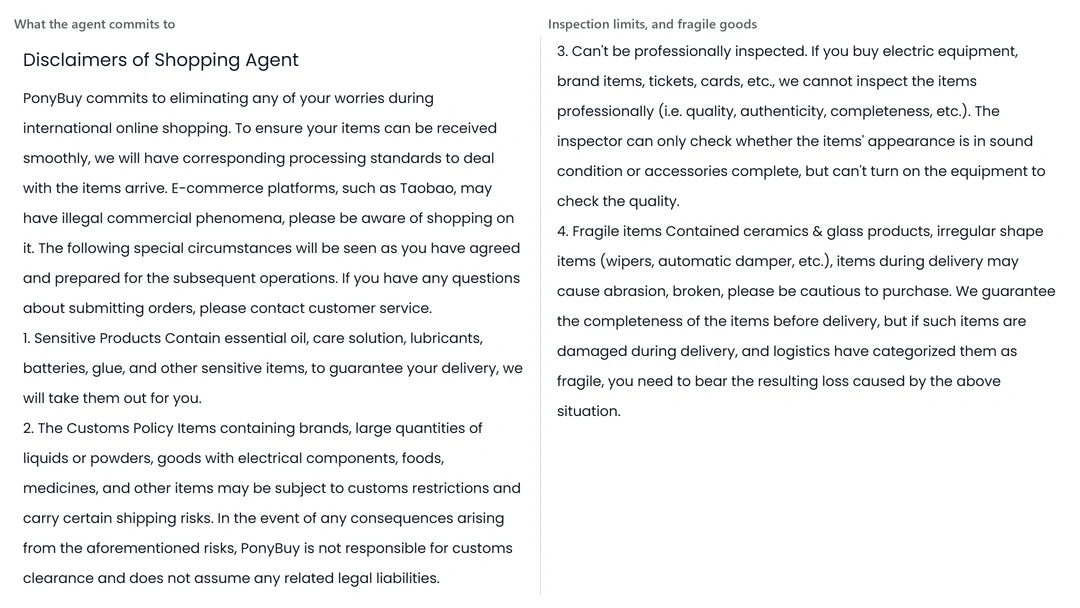
There is a document called Disclaimers of Shopping Agent, and it is the most honest page in the whole help centre. It is a list of the situations where the agent tells you in advance that it will not be able to help, and every one of them is a buying decision you make before the order exists.
The first four are in the figure. Sensitive products get removed from the parcel rather than shipped. Goods that customs may restrict are your risk, not PonyBuy. Electrical and branded items cannot be professionally inspected, which is stated flatly rather than hedged. Fragile items damaged in delivery are carried by the buyer.
Read that list as a shopping list in reverse. Every item on it is a category where the photographs, the inspection and the after-sales process are all thinner than you assume, and where the seller you picked is doing more of the work than the agent is.
What makes a useful spreadsheet, and what makes a decorative one
Since you are reading one, it is only fair to say what this site thinks the test is. None of the left hand column is difficult to provide, which is the point: the sites that do not provide it have chosen not to.
Worth your time
- It shows where a rule came from and links to the page, so you can check that it still says that.
- It dates what it read, because agent rules change and an undated claim has no shelf life.
- It is explicit about what it does not know, including when two official pages contradict each other.
- It separates community vocabulary from published policy. Batch, GL and RL carry no rules; stocked in and sealed carry several.
- It discloses how it earns, in a sentence, near the links that earn it.
Decorative at best
- Prices, fees and delivery times quoted as fact with no source and no date. Those are the figures that move most.
- Authenticity claims about goods nobody at the site has held, on a page that also tells you the agent cannot authenticate anything.
- Batch verdicts presented as policy, as though a warehouse somewhere signed off on them.
- Rankings of agents with no method and no disclosure, which usually means the order is the commission order.
- Pages that exist for a keyword and answer no question you could ask out loud.
Judging a listing before you pay for it
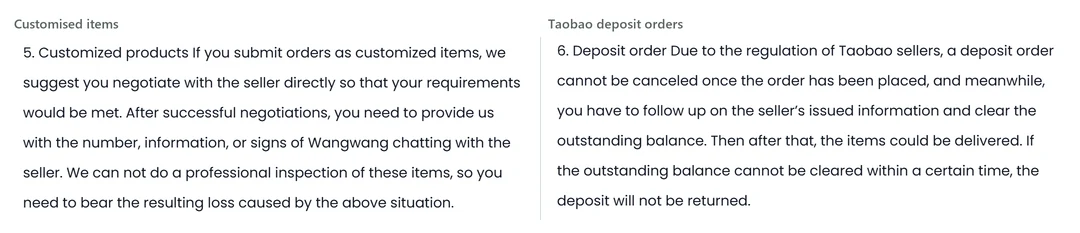
Two order types in the disclaimer deserve their own section, because both remove protections quietly and neither looks unusual on a listing page.
Customised orders come first. PonyBuy asks you to negotiate the details with the seller yourself, hand over the record of that conversation, and accept that no professional inspection is possible. A made to measure piece therefore arrives with no inspection to appeal to and no standard to appeal against, and the conversation you had before paying is the entire specification.
Deposit orders come second and are harsher. Once placed they cannot be cancelled, and if the balance goes unpaid past the seller deadline the deposit is forfeited. Preorder drops are usually deposit orders. The decision point is the deposit, not the balance, which means the moment you feel like you are only reserving a place is the moment you have committed.
Choosing an agent, and what is actually worth comparing
Most agent comparisons rank on fees and shipping quotes, which are the two things that change weekly. These five are structural, and they are checkable in an afternoon without placing an order.
Read the disclaimer before the homepage
Every serious agent publishes one. It tells you which categories it quietly will not stand behind, and that is worth more than any feature list.
Find the inspection scope in writing
Not a marketing page about quality: the document that says what is checked and what is excluded. If it is not written down, it is not a commitment.
Work out when the return clock starts
PonyBuy starts it at the next full hour after stocked in and runs it five days. An agent that leaves this vague has left itself room.
Check what a paid photograph costs and what it is capped at
This is the only lever you have over an inspection. An agent that does not offer one has given you no way to look closer.
Look for the clause that says who pays when it goes wrong
Return legs, appraisal costs, damage in domestic transport. The agent that publishes a responsibility table has thought about the argument in advance.
Ignore the leaderboards
Including any you find on sites like this one. An unexplained ranking of agents is a commission order with a headline on it.
What a counterfeit complaint has to carry, and who pays for it
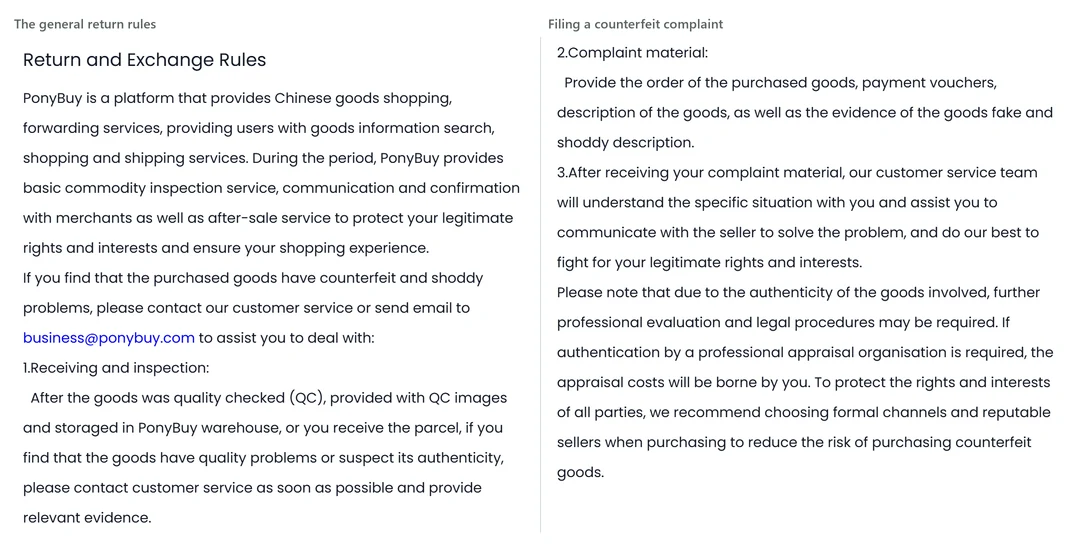
For a reps buyer this is the clause with the sting in it, and it is published openly rather than buried. The complaint material is a list of four things, three of which already exist in your account.
The fourth is evidence. That is where the detailed photographs you ordered while the goods were still in the warehouse stop being a curiosity and start being the case. Evidence gathered after the parcel reached you is weaker, because the chain between the warehouse and your door now has a gap in it.
Then comes the sentence people do not expect. If a professional appraisal is needed, you pay for it. A counterfeit claim is not a free escalation; it is a decision with a cost attached, and the cost is yours whichever way the appraisal goes.
Provide the order of the purchased goods, payment vouchers, description of the goods, as well as the evidence of the goods fake and shoddy description.
Please note that due to the authenticity of the goods involved, further professional evaluation and legal procedures may be required. If authentication by a professional appraisal organisation is required, the appraisal costs will be borne by you. To protect the rights and interests of all parties, we recommend choosing formal channels and reputable sellers when purchasing to reduce the risk of purchasing counterfeit goods.
Quoted from PonyBuy's help centre, Return and Exchange Rules, re-read 2026-09-22.
The seller test the agent publishes about its own marketplace
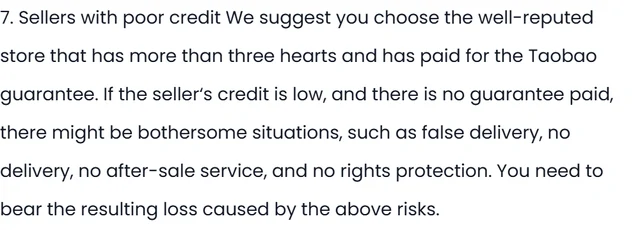
The seventh special circumstance is the bluntest paragraph PonyBuy has written about the goods it buys, and it is a test you can apply before you order anything.
It says to pick a well-reputed store with more than three hearts that has paid the Taobao guarantee. It then says what a low-credit seller with no guarantee can mean: false delivery, no delivery, no after-sales service and no rights protection, with the loss staying where it lands, which is with you.
Nothing in that paragraph is about reps specifically, and that is what makes it useful. It is a marketplace telling you that its own floor is uneven and that the seller rating is the railing. If an agent will not stand behind a bad seller, then choosing the seller is the part of the order you cannot delegate, and no quantity of photographs afterwards substitutes for it.
Four questions worth settling before the order exists
Every answer here comes from the disclaimer or the return rules, both linked in the sections above.
- What is the single best predictor of a bad order?
The seller. PonyBuy says so itself, in a disclaimer that recommends you pick a well-reputed store rather than relying on the agent to catch problems.
- Are customised orders inspected?
No. PonyBuy lists them as a special circumstance, asks you to negotiate with the seller yourself, and states that no professional inspection is possible.
- Can I cancel a deposit order?
PonyBuy states that once placed it cannot be cancelled, and that leaving the balance unpaid past the seller deadline forfeits the deposit.
- How do I judge a spreadsheet site itself?
By whether it shows its sources and its dates. A page that quotes an agent rule without linking the rule is asking you to take its word for it.